



Engineering
Four open models against Qwen3.8-27B, and only Inkling 2 Mini keeps up
Inkling 2 Mini ties Qwen3.8-27B on grounded video QA with an eighth of Qwen's active parameters, and runs 20% faster on the same GPU. Nemotron 3.5 Super and DeepSeek V4.1 Flash are several times Qwen's size, and Nemotron 3 Nano Omni is about the same size with 3B active parameters. All three score lower. Where each model loses its points, and how to get the most out of Inkling.
Most posts in this series compare frontier API models at the top of the table. This one looks at the open-weights models. In the first post, self-hosted Qwen3.8-27B reached 84% of Gemini 3.7 Flash's score, and it is the default vision-language model on our own hardware. We have run four more open-weights models through the same pipeline and the same 300 questions: Thinking Machines' Inkling 2 Mini and NVIDIA's Nemotron 3 Nano Omni and Nemotron 3.5 Super, which we host ourselves, and DeepSeek V4.1 Flash, which we called through Nebius Token Factory.
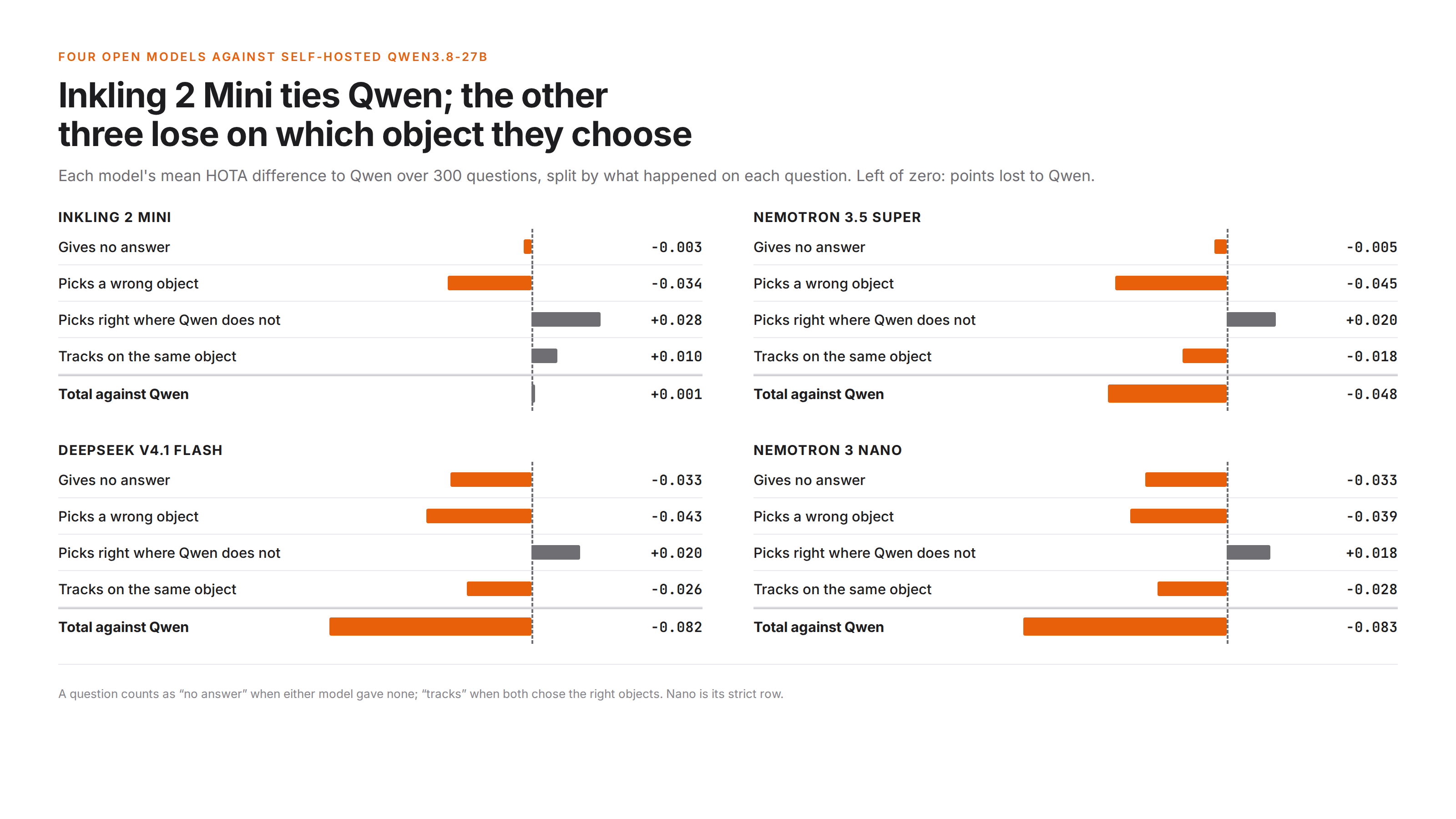
Inkling 2 Mini is the first open model that keeps up with Qwen: 0.482 HOTA against 0.481, with 3.4B active parameters against Qwen's 27B. Nemotron 3.5 Super and DeepSeek V4.1 Flash are several times Qwen's size, and Nemotron 3 Nano Omni is about the same size with 3B active parameters. All three score lower. Super is the closest, 0.048 behind. DeepSeek and Nano are both about 0.08 behind. Each of the three has its own way to give no answer at all, but most of their gap is the same: they choose the wrong object more often than Qwen does.
The short version: Qwen3.8-27B scores 0.481 HOTA and Inkling 2 Mini 0.482. Nemotron 3.5 Super scores 0.432, DeepSeek V4.1 Flash 0.398 and Nemotron 3 Nano Omni 0.398 (strict; 0.424 as run). Inkling chooses the right object more often than Qwen and draws tighter tracks, but it adds extra objects to its answers twice as often, and the two effects cancel. Its box-drawing stage gives the same score at the lowest reasoning effort, with half the output and no reasoning loops. The other three lose about 0.04 to wrong objects and 0.02 to 0.03 to looser tracks. DeepSeek reads "do not answer yet" literally and returns empty plans. Super sometimes writes clock times as decimals and returns no box for some small objects.
The setup
The pipeline, the 300-question sample from the Perception Test training split, and the official HOTA scorer are the same as in the first post. All six models below ran the current version of the pipeline, in which stage 3 refers to objects by number (Astra post). SAM 3 carried every box. Each model reasoned before it answered:
- Qwen3.8-27B, dense, FP8, with vLLM and a 128k context. It thinks in stages 1 and 2, with a 32,768-token budget, and not in stage 3.
- Inkling 2 Mini, 26B parameters with 3.4B active, NVFP4, on one rented RTX PRO 6000 Blackwell with vLLM. Its middle layers run three times per token, so it computes like a model of about 5.4B active parameters. It takes images but no video, so each clip goes as one image per frame. Reasoning effort
high, its default, in every stage. - Nemotron 3.5 Super, 120B parameters with 12B active, NVFP4, on the same kind of GPU with vLLM. Reasoning is on, with the model card's 16,384-token budget.
- Nemotron 3 Nano Omni, 30B parameters with 3B active, FP8, on the same GPU with the same reasoning budget.
- DeepSeek V4.1 Flash, 763B parameters, the pinned 1017 snapshot, served at fp8 by Nebius Token Factory, at reasoning effort
high.
Two details about the scores. Nano's row is its strict score. Its run on the current pipeline reused the first two stages of an earlier run, but on 24 questions that run had named no object, so there was nothing to reuse and those questions ran the first two stages a second time. That gives a declined answer a second try, so the strict row keeps their earlier result (as run, Nano scores 0.424). And some calls of DeepSeek (23) and Inkling (4) failed because they reasoned until they hit the output cap. They ran once more, as our retry policy allows. 5 of DeepSeek's failed again and 1 of Inkling's.
Results
| Model | HOTA | Right object | No answer | Box overlap | Model minus Qwen, 95% CI |
|---|---|---|---|---|---|
| Gemini 3.7 Flash (reference) | 0.5702 | 90.0% | 4 | 0.928 | +0.090 [+0.058, +0.121] |
| Inkling 2 Mini | 0.4822 | 88.0% | 6 | 0.875 | +0.002 [−0.027, +0.031] |
| Qwen3.8-27B | 0.4807 | 85.0% | 1 | 0.860 | |
| Nemotron 3.5 Super | 0.4324 | 76.0% | 9 | 0.829 | −0.048 [−0.079, −0.018] |
| DeepSeek V4.1 Flash | 0.3984 | 79.0% | 22 | 0.706 | −0.082 [−0.115, −0.049] |
| Nemotron 3 Nano Omni, strict | 0.3979 | 78.3% | 27 | 0.846 | −0.083 [−0.116, −0.051] |
All models on the same pipeline and 300 questions. "No answer" counts the questions where the model named no object, returned no box, or failed on a call. Box overlap is the median IoU with the answer on the frame that stage 2 chose. The interval is a paired bootstrap of the per-question difference.
Inkling and Qwen are level: Inkling wins 144 questions, loses 132 and ties 24 (signed-rank p = 0.79). The other three gaps to Qwen are clear (p < 0.001). Among them, Super is ahead of DeepSeek (+0.034, CI [+0.005, +0.063]). DeepSeek and Nano are level (+0.0005). Super is ahead of Nano by 0.035 on average, but not consistently across questions (p = 0.14).
So parameters do not decide the order. Super has more than four times Qwen's parameters, and DeepSeek about 28 times. Inkling has about as many in total as Qwen, but it uses only 3.4B of them per token, and it is level. Super and Nano are mixture-of-experts models too, with 12B and 3B active parameters. Qwen is dense: all 27B of its parameters work on every token.
Where the points go
For each question, we compared the model's answer with Qwen's and sorted the difference into four outcomes:

For Super, DeepSeek and Nano, two outcomes look almost the same:
- Wrong objects cost about 0.04. Each model chose a wrong object, or too few or too many objects, on questions where Qwen chose right. That costs it 0.039 to 0.045. On other questions, the model chose right where Qwen did not, which gives back about 0.02. Net, each model loses about 0.02 to Qwen on object choice.
- Looser tracks cost 0.018 to 0.028. When the model and Qwen chose the same objects, Qwen's tracks still scored higher. DeepSeek's boxes are the loosest: on the smallest third of answer objects, its median overlap is 0.678, against 0.808 for Qwen.
Inkling is different on both. It wins back more where only it chooses right (+0.028), and its tracks are better than Qwen's (+0.010). It loses 0.034 on object choice, and most of that loss is one habit, described below.
The third outcome separates the other three. Giving no answer costs Super only 0.005, but DeepSeek and Nano 0.033 each. Each model fails to answer in its own way.
Inkling 2 Mini: a tie made of two differences
Inkling chooses better than Qwen. It names all the answer objects on 88.0% of the questions, against 85.0%. On 30 questions only Inkling chooses right, against 21 where only Qwen does. On the 169 questions where both models name exactly the answer objects, Inkling's tracks score 0.594 against 0.569, and its median box overlap is 0.875 against 0.860.
But Inkling hedges. When it cannot tell which of two objects the question means, it often names both: "the ring" and also "the object that the ring stops against", or a second cup in a shell game. Asked which objects moved while the camera looked away (the figure below), it named the mug that moved, and also a handbag and a notebook that did not. It names more objects than the answer has on 45 questions, against 22 for Qwen. On the 38 questions where its list holds every answer object and one more, it scores 0.408, against 0.496 for Qwen. The extra track counts against it on every frame, and that cancels its lead.
By question type, the two models are level almost everywhere. Inkling is a little ahead on letters, shapes and cards (+0.018) and on launches (+0.014), and level on shell games (0.386 against 0.383) and on what changed while the camera looked away (0.494 against 0.507). It is behind on answers with four or more objects (0.357 against 0.399) and on 9 questions about colour, shape and transparency (−0.071). It also asks stage 2 for a high frame rate about half as often as Qwen (65 times against 119).
Inkling gave no answer on 6 questions. On 4, stage 3 found nothing to box, and the model said why: the object is hidden on that frame. On 1, its stage-1 plan was empty, with the reason "Plan only, not the final tracked answer": the same literal reading of "Do not answer the question yet" as DeepSeek's, but once instead of 16 times. On 1, a call reasoned until it hit the output cap, twice.
Reasoning effort, speed and cost
Inkling's chat template takes a reasoning effort from none to max. Its default is high. The model card says that even the lowest setting does not stop the reasoning, and that the model can loop in its reasoning. We saw both. At high, 4 calls reasoned until they hit the output cap three times in a row, and the box-drawing stage spent 2.13 million output tokens: a median of 487 per call, where Qwen, with thinking off, spends 43.
Stage 3 only draws boxes on objects that stage 1 already chose, on frames that stage 2 already chose. So we re-ran only stage 3, at none, and kept stages 1 and 2 from the published run:
| Inkling, stage 3 | HOTA | Stage-3 output tokens | Median call | Failed calls |
|---|---|---|---|---|
high (default) |
0.4822 | 2.13M | 487 | 4 |
none |
0.4841 | 1.06M | 348 | 0 |
The score does not change: +0.002, CI [−0.007, +0.011], with 105 questions won, 104 lost and 91 tied. The output halves, and no call loops. The question that failed twice at high now has an answer. none still reasons, as the card says: 348 tokens per median call.
To compare speed, we ran the same 50 questions through Inkling and Qwen, one after the other, on the same RTX PRO 6000, with the same vLLM build and 16 requests at a time. Each model ran with its own settings from the table: Qwen thinks in stages 1 and 2 only, and Inkling reasons at high in every stage. Neither used speculative decoding.
| 50 questions, one RTX PRO 6000 | Inkling 2 Mini | Qwen3.8-27B |
|---|---|---|
| Wall time | 24.2 min | 30.3 min |
| Output tokens | 646k | 405k |
| Output tokens per second | 446 | 223 |
| Median time per question | 173 s | 258 s |
| GPU cost per hour of video, at $1.80 per GPU hour | $2.25 | $2.82 |
Inkling writes 60% more output than Qwen and still finishes 20% sooner, because it decodes about twice as fast. It computes with far fewer parameters per token. Half of its output is in stage 3, which none halves, so the gap should grow at that setting; we did not time it. On all 300 questions, Inkling took 2.3 GPU hours, or $2.15 per hour of video at Nebius's on-demand price.
Three ways to give no answer
DeepSeek plans and stops. Our stage-1 prompt says: "Do not answer the question yet. Plan how it should be answered." Every other model then names the objects that answer the question. On 16 of 300 questions, DeepSeek did what the first sentence says.

On 13 of the 16, DeepSeek's own reason says that it is only planning. On some, the reason names the answer objects and the object list is still empty, so the model knew the answer and held it back. Plural questions trigger it: 13 of the 151 questions that contain the word "objects" got an empty plan, against 3 of the other 149. DeepSeek also had 5 calls that reasoned until they hit the 16,000-token cap of stage 3, on a retry too.
Super means 8 seconds and writes 0.08. Super thinks in clock time. Our schema already accepts a time such as "00:08" as text. But Super also writes clock times as decimal numbers, and 0.08 is a valid number of seconds.

On 5 of 300 questions, all of Super's keyframe times fall in the first second of the clip. Its other no-box answers are mostly about small objects (a marble, a bottle cap, a small block) or objects named by printed text ("the card showing the eight of spades"). In all 9, stage 3 found nothing to box on any keyframe.
Nano gives no answer on 10 questions. It named no object on 5 questions and found no box on 5. The other 17 of its 27 no-answers come from our accounting, not from the model: the strict row keeps those questions at zero from its earlier run.
None of these explains the whole gap. If every no-answer question had the model's average score, Super would read 0.446, Nano 0.437 and DeepSeek 0.430. All three would still be below Qwen.
Where Qwen is strong: what changed while the camera looked away
On 23 questions, the camera looks away and something on the table changes. Qwen scores 0.507 on them, level with Gemini 3.7 Flash (0.512), and Inkling scores 0.494. Super scores 0.369, DeepSeek 0.324 and Nano 0.321.

Qwen's reasoning for this question is a method: "Compare the opening view (0-5s) with the view after the camera returns from the papers (11-16s)", followed by a list of what stayed in place. Qwen and Inkling answered all 23 of these questions. DeepSeek gave no answer on 4 of them (all empty plans), Nano on 4 and Super on 1.
Each model's profile
Inkling 2 Mini chooses the right object more often than Qwen and draws tighter boxes, and it gives an answer nearly every time. It hedges between candidates, and it is weaker on long object lists. It reasons in every stage and at every effort level, and at high a few calls loop until the output cap.
Nemotron 3.5 Super is close to Qwen on letters, shapes and cards (−0.010) and on the questions about what keeps a box from closing. It almost never asks stage 2 for a high frame rate: 12 times in 300 questions, against 119 for Qwen. Its boxes for small objects are loose (median overlap 0.738, against 0.808 for Qwen), and on some it finds no box at all.
DeepSeek V4.1 Flash is level with Super on single-object answers (−0.050 against Qwen) and far behind on answers with two or more objects (−0.130, CI [−0.171, −0.089]). It is near Qwen on launches (−0.014) and containers (−0.036). In shell games, it names the cup instead of the hidden object on 9 of 44 occluded-object questions (Qwen 3, the Nemotrons none). When it asks for a high frame rate in a shell game, it scores 0.152 on those 42 games, against 0.380 on the rest. Its boxes are unbiased, centred and the right size on average, but about three times noisier than the frontier models' boxes. Through Nebius, the run cost $9.95, or $5.20 per hour of video. That is more than Gemini 3.7 Flash ($3.70) for a much lower score.
Nemotron 3 Nano Omni loses most on launches (−0.091) and on containers and pouring (−0.161), and through its declines. When it answers, its boxes are close to Qwen's (median overlap 0.846, against 0.860).
Shell games are hard for every open model. On shell games, Inkling scores 0.386, Qwen 0.383, Super 0.333, Nano 0.300 and DeepSeek 0.288, against 0.513 for Gemini 3.7 Flash. Qwen's keyframe boxes land on a different object 20.7% of the time, and Flash's 4.1%. The open models move the tracker to an identical cup much more often than any of the closed models we have tested.
How to get the most out of Inkling 2 Mini
Only the stage-3 setting in the first point is measured. The rest follow from what we saw, but we have not tested them.
- Set the reasoning effort per task, not per model. Where the model only has to look, as in drawing a box on an object that is already chosen,
nonegave the same score with half the output and no loops. Where the model has to decide, as in choosing which object answers the question, keephigh: that is where Inkling beats Qwen, and we have not measured it lower. In a production pipeline the same split applies:noneorlowfor describing, verifying or classifying what is in a frame, andhighfor questions about what happened. - Cap the output of every call. The model card warns about reasoning loops, and at
highwe hit them on about 1 question in 75. A cap turns a loop into a failed call that a retry can recover; our retry recovered 3 of 4. Atnonein stage 3, no call looped. - Ask for one object when the question has one. Inkling's hedging costs it about 0.088 on 38 questions, or about 0.01 over the whole set. A plan prompt that says "if two objects could be meant, choose the more likely one" could recover part of that. It would change the prompt for every model, so it needs a re-run of the field.
- Send frames, not video, and send many of them. Inkling has no video input, but it handled our 120-frame stage-3 windows without decimation. Label each frame with its time, as we do, so the model can reason about when things happen.
- Serve it where its fast path works. Its vLLM recipe uses DSpark speculative decoding, and the recipe is verified on Hopper and data-centre Blackwell GPUs. On our RTX PRO 6000 with an older driver, the vLLM nightly build could not load its FlashAttention kernels, so we ran without DSpark and with PyTorch attention in the image encoder. Speculative decoding does not change the answers, only the speed.
Strengths, weaknesses and what could be better
Strengths. Inkling 2 Mini is the first open model that ties Qwen3.8-27B, and it chooses the right object more often. Qwen stays as good as Gemini 3.7 Flash on the memory questions, and Inkling is close behind there. Super gives an answer nearly every time and is close to Qwen on letters and shapes. DeepSeek picks the right object more often than Super (79.0% of the questions against 76.0%) and has nothing to host.
Weaknesses. Inkling hedges between candidates and reasons in every call. Super, DeepSeek and Nano lose to Qwen on which object they choose, and every open model swaps identical cups often. DeepSeek reads part of the prompt literally, struggles with answers that have several objects, and draws loose boxes. Super writes some clock times as decimals and finds no box for some small objects. Nano gave no answer on 10 questions, and its strict row keeps 17 more at zero.
What could be better. Apart from Inkling's stage-3 effort, we have not tested any of these changes.
- Read Super's clock times correctly. Accept a time only as "mm:ss" text in the stage-2 schema, so that a decimal number cannot be read as seconds. This affects 5 questions.
- Change the stage-1 wording. "Do not answer the question yet" exists so that the plan comes before the answer. A wording such as "Name the objects first, then explain how to find them" would keep that order without an instruction to hold back. DeepSeek misread it 16 times and Inkling once. Because every model gets the same prompt, this needs a full re-run of the field.
- Zoom in on small objects in stage 3. Super and DeepSeek both lose most on small objects. A crop around the expected position could help, at the cost of one more call per box.
Even with all of their no-answer questions at their average score, none of Super, DeepSeek or Nano would pass Qwen. Closing their gap would need better object choice, not only fewer failures.
What this means in practice
If you host a vision-language model yourself for video, Qwen3.8-27B and Inkling 2 Mini are now level on accuracy. On one GPU, Inkling does the same work about 20% faster, at about $2.25 per hour of video against $2.82, and its box-drawing step can run at the lowest effort. Qwen gives an answer a little more often, never looped in our runs, and takes video directly, where Inkling needs a list of frames. Nemotron 3.5 Super runs on one 96 GB GPU too, but it is less accurate than both.
If you want open weights without hosting them, DeepSeek V4.1 Flash is not a good choice for this task. It costs more per hour of video than Gemini 3.7 Flash and scores 0.17 lower.
If your questions are about what changed while the camera was away, Qwen is as good as the frontier Flash model.
Limitations
- Every figure comes from the same 300 training questions as the earlier posts. Results for groups of fewer than 30 questions, such as the 23 memory questions, are indicative only.
- We timed only Inkling and Qwen on the same hardware, on 50 questions. Neither used speculative decoding, and both ran with PyTorch or Triton attention instead of FlashAttention, because the GPU driver could not load the FlashAttention kernels of this vLLM build. The other models ran on different hardware or as a service, so we do not compare their speed.
- Nano's strict row keeps 24 re-run questions at their earlier score. DeepSeek's and Inkling's rows include one retry of their failed calls; 5 and 1 questions still failed.
- Each model ran with its own reasoning setting: a thinking budget for Qwen and the Nemotrons, and an effort level for DeepSeek and Inkling.
Agnify answers questions like these from the cameras already on a production floor. To see the pipeline on your own footage, read about Agnify for manufacturing or book a demo.
FAQ
Which open-weights model is best for grounded video QA?
In our tests, Qwen3.8-27B and Inkling 2 Mini are level: 0.481 and 0.482 HOTA on 300 Perception Test questions (difference +0.002, 95% CI [−0.027, +0.031]). Nemotron 3.5 Super scores 0.432, DeepSeek V4.1 Flash 0.398 and Nemotron 3 Nano Omni 0.398 (strict; 0.424 as run). Those three are clearly below Qwen (p < 0.001).
Is Inkling 2 Mini better than Qwen3.8-27B?
Not on accuracy: the two are level. Inkling chooses the right object more often (88.0% of the questions against 85.0%) and draws tighter boxes, but it adds an extra object to its answer twice as often, and the two effects cancel. It is faster on the same GPU: 24 minutes for 50 questions against 30, at about twice as many output tokens per second.
Which reasoning effort should I use for Inkling 2 Mini?
It depends on the step. For drawing boxes on objects that are already chosen, none gave the same score as the default high, with half the output tokens and no reasoning loops. For choosing which object answers a question, we used high and did not test lower. none does not turn reasoning off: the median box-drawing call still spent 348 output tokens.
Is Nemotron 3.5 Super better than Qwen3.8-27B?
No. Super is 0.048 HOTA behind Qwen (95% CI [−0.079, −0.018]). It chooses the right object on 76.0% of the questions, against 85.0% for Qwen. It runs on one 96 GB GPU at NVFP4 precision.
Why does DeepSeek V4.1 Flash return empty answers?
Our first stage asks each model to plan before it answers, with the sentence "Do not answer the question yet". On 16 of 300 questions, DeepSeek took that literally and named no object. Questions that ask for several objects trigger it most.
How does DeepSeek V4.1 Flash compare with Gemini 3.7 Flash on cost?
Through Nebius Token Factory, DeepSeek cost $9.95 for the 300-question run, or $5.20 per hour of video. Gemini 3.7 Flash costs $3.70 per hour of video and scores 0.172 HOTA higher.