




Engineering
Gemini 4 Neon catches GPT-6 Astra, at almost six times Terra's price
Gemini 4 Neon is the first Gemini that scores level with GPT-6 Astra on grounded video QA, and it no longer confuses the cup with what the cup hides. It thinks longest on the questions it still gets wrong, and it costs $46.60 per hour of video.

Google released Gemini 4 Neon on 18 November, at $3 / $15 per million input / output tokens, twice Hydrogen's rate. Google places it between the two models we tested last week: Carbon "tackles your hardest, long-horizon projects", Hydrogen does fast everyday work, and Neon "balances depth and efficiency". We ran it through the same pipeline and the same 300 questions as Carbon and Hydrogen.
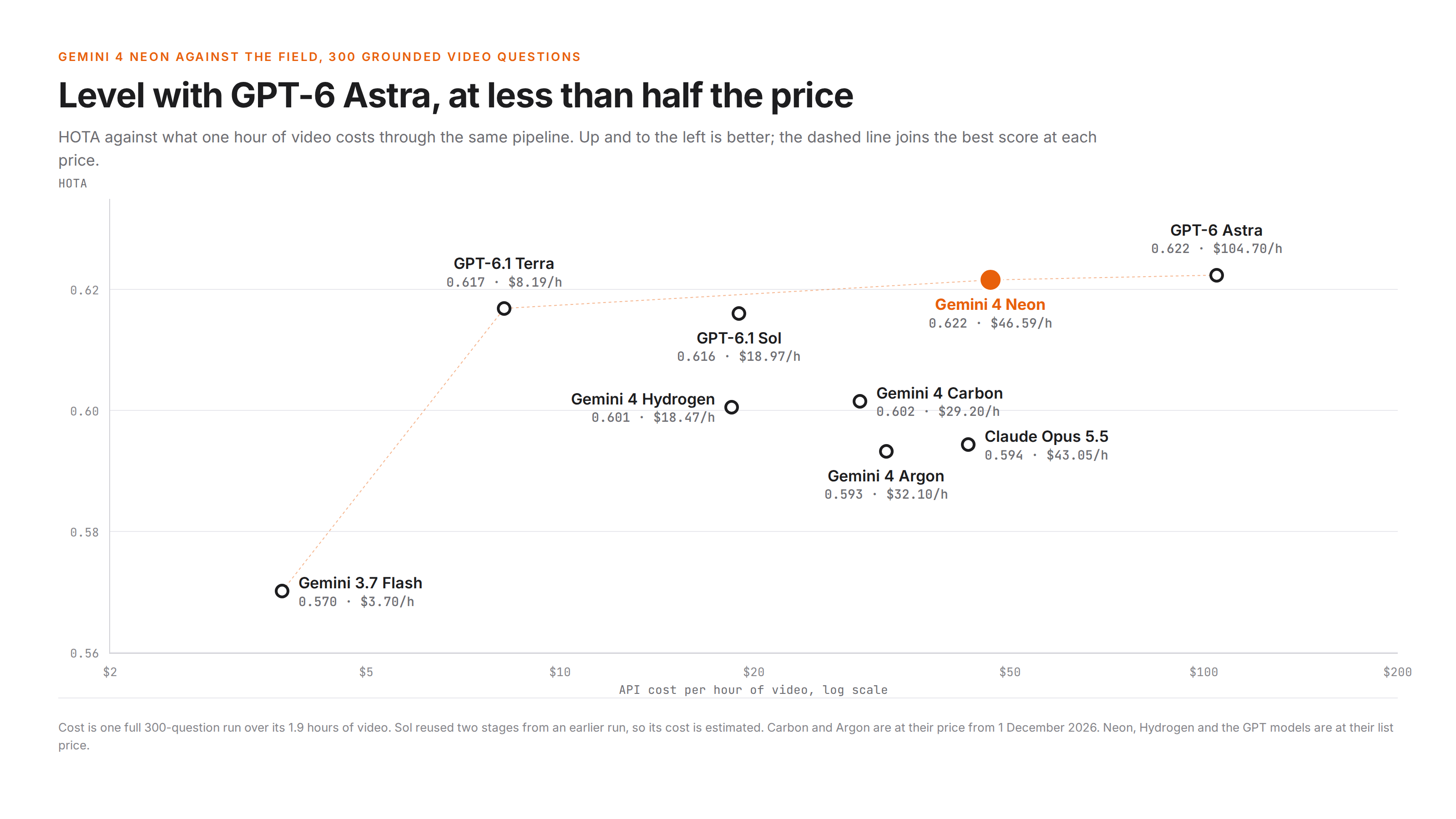
Neon scores 0.6216 HOTA. That is the best Gemini result in this series, clearly ahead of Carbon and Hydrogen, and level with GPT-6 Astra (0.6224), the best model we have tested. It is also level with GPT-6.1 Terra, which costs a sixth as much.
The short version: Gemini 4 Neon scores 0.622 HOTA for $46.60 per hour of video. It ties GPT-6 Astra ($105) and GPT-6.1 Terra ($8.19), and it is +0.020 ahead of Gemini 4 Carbon and Hydrogen. It is the first Gemini that chooses the right object on every shell game. All of its gain over Hydrogen is in which object it chooses, not in its boxes. It thinks longest on launches and letters, the two question types where it is still behind Astra, and it is the slowest Gemini 4 model.
The setup
The pipeline, the 300 questions from the Perception Test training split and the official HOTA scorer are the same as in the earlier posts. Neon ran all three model stages from scratch at its default thinking level, and SAM 3 carried its boxes on the same RTX PRO 6000 Blackwell as the other runs.
Three details matter if you call Neon yourself:
- Give the reasoning stages a large output cap. On 24 of about 2,000 calls, Neon used all 8,192 output tokens of stages 1 and 2 on thinking and returned no answer. Hydrogen did this on 14 calls. One more call timed out four times. We ran those 25 questions again with a 32,768-token cap, and 24 answered. If they had scored zero, Neon would read 0.575.
- The thinking level changes little. Google says that Neon's default is
high. On a short puzzle about three cups, Neon thought for 78 to 256 tokens atlow,medium,highand the default alike. Onlyxhighthought longer, 345 to 426 tokens. The API rejectsminimal. This is the same pattern as Hydrogen's. - Neon is slow. With 16 parallel requests, the median question took 130 seconds through stages 1 to 3, against 73 for Hydrogen and 96 for Carbon. The first pass over the 300 questions took 57 minutes, against 36 for Hydrogen.
Results
| Model | HOTA | Right object | Per video hour | Neon minus model |
|---|---|---|---|---|
| GPT-6 Astra | 0.6224 | 97.3% | $105 | −0.001 [−0.018, +0.016] |
| Gemini 4 Neon | 0.6216 | 96.0% | $46.60 | |
| GPT-6.1 Terra | 0.6169 | 94.3% | $8.19 | +0.005 [−0.012, +0.022] |
| GPT-6.1 Sol | 0.6161 | 96.7% | $19* | +0.006 [−0.012, +0.023] |
| Gemini 4 Carbon | 0.6016 | 94.3% | $29.20† | +0.020 [+0.009, +0.033] |
| Gemini 4 Hydrogen | 0.6006 | 93.0%‡ | $18.50 | +0.021 [+0.005, +0.039] |
| Claude Opus 5.5 | 0.5944 | 92.7% | $43 | +0.027 [+0.010, +0.046] |
| Gemini 4 Argon | 0.5933 | 92.3% | $32† | +0.028 [+0.014, +0.044] |
| Gemini 3.7 Flash | 0.5702 | 90.0% | $3.70 | +0.051 [+0.031, +0.072] |
All models on the same pipeline and 300 questions. The cost is the API bill for one full run, divided by the 1.9 hours of video that the run covers. Under each difference, its 95% interval from a paired bootstrap of the per-question difference. *Sol reused stages 1 and 2 from an earlier run, so its cost is an estimate. †The price from 1 December 2026. ‡In the last post we first gave Hydrogen's rate per answer object, 95.1%. Per question, as for the other models, it is 93.0%. That post now shows the correction.

Neon is the first Gemini 4 model that is clearly ahead of Carbon and Hydrogen. Against Hydrogen the signed-rank test does not confirm the gain (p = 0.16), but against Carbon it does (p = 0.03). Against Astra, Terra and Sol, the intervals include zero.
Where the gain comes from: choosing the object
When Neon and Astra choose the same objects, which they do on 285 of 300 questions, their scores are the same: Neon is +0.003 on those questions. The rest of the difference is in the few questions where only one of the two chooses right: 7 for Astra, 3 for Neon.
Against Hydrogen, the picture is one-sided. Neon chooses the right objects on 12 questions where Hydrogen does not, and Hydrogen on 3 where Neon does not. Those 15 questions give Neon +0.014 of its +0.021 lead. On the 276 questions where both choose right, Neon is only +0.007. So Neon is a better reader of the question, not a better box-drawer.
Two of the weak points that we found in the earlier Gemini 4 models are gone:
- The shell game is now a tracking problem only. Neon chooses the right object on all 104 shell games. On the 44 questions that ask for the hidden object, it never names the cup that hides it, and it never names both the object and the cup. Argon named the cup on 13 of them, Carbon on 3, and Hydrogen named both on 4. What is left is the tracker's anchors: on 15 games, one of Neon's keyframe boxes lands on another cup (Hydrogen 18, Terra 10, Astra 8). So on shell games Neon is still 0.013 behind Astra.
- Single objects are no longer a weak spot. On the 179 questions with one answer object, Neon scores 0.628, level with the three OpenAI models (0.624 to 0.630). Carbon and Hydrogen were behind them there, at 0.612 and 0.605. Neon keeps the Gemini 4 strength on long lists: on four or more objects it scores 0.541, level with Astra (0.543) and above Terra (0.486).
The Gemini habit of many keyframes is unchanged. Neon never answered with one keyframe, and on what changed while the camera looked away (23 questions) it scores 0.555, against 0.495 for Astra and 0.471 for Terra. The sample is small.
Where it thinks, and where it still loses
Neon puts more of its thinking into choosing than the other Gemini 4 models do. In stages 1 and 2, its median question used 4,621 output tokens, against 2,628 for Hydrogen and 1,576 for Carbon. The thinking is not spread evenly. All 24 calls that ran into the cap came from three question types: 12 of the 70 launch questions, 9 of the 63 letter and shape questions, and 3 of the 104 shell games. On 17 of them, the model thought to the cap before it named any object.
Those are the questions where Neon is weakest. On the 25 questions that needed a second run, Neon scores 0.555, against 0.628 on the rest. On them it is far ahead of Hydrogen (+0.090), but behind Astra (−0.055). On the other 275 questions, Neon and Astra are level (+0.004). Most of what Neon still gets wrong is the same as for Carbon:
- Launches. Neon chose a wrong object on 5 of 70 launch questions, against 2 for Astra. On two of them, the question asks for "the object that stops the motion of the launched object after being launched the first time". Neon answered "the person", who catches the ball at the end, as Carbon and Argon did. The one question that failed twice, at 32,768 tokens, is also of this kind.
- Letters. Neon chose a wrong object on 5 of 63 letter and shape questions, against 3 for Astra. It names letters by what happens to them, for example "the orange letter cutout that the person pulls toward the edge of the table", not by the letter. A name like this cannot be found in one still frame, so stage 3 must work out which letter it means.
So more thinking did not fix the questions that Carbon also got wrong. It fixed the questions that Hydrogen got wrong.
Where the money goes
Neon's run cost $89.17: 9.8 million input tokens and 4.0 million output tokens. That is 2.5 times Hydrogen's bill. The price per token is two times as high, and Neon writes 25% more output tokens.
As with Hydrogen, more than half of the output, 2.32 million tokens, goes to stage 3, which only draws boxes on objects that stages 1 and 2 already chose. With its share of the input, stage 3 costs about $46 of the $89. Neon's thinking there is shorter than Hydrogen's at the extremes (the longest call is 31,000 tokens, against 62,000), but its median one-object call is longer (480 tokens, against 387 for Hydrogen and 47 for Carbon). It buys little: on the 276 questions where Neon and Hydrogen choose the same objects, Neon is +0.007, and its median box overlap on the chosen frame is 0.940, against 0.936 for Hydrogen and 0.934 for Carbon.
Calls that end without text report no token use, so the bill above leaves out the thought of the 25 failed first attempts, at least $3.
Strengths, weaknesses and the best way to use it
Strengths. Neon chooses the right object on 96.0% of the questions, the best Gemini rate and close to Sol (96.7%) and Astra (97.3%). It no longer mistakes the cup for what it hides, it does well on single objects and on long lists, and it shares the best score with Carbon on what changed while the camera looked away. When it chooses the same objects as Astra, its tracks are as good.
Weaknesses. It is expensive and slow for what it adds over Terra. It thinks longest on launches and letters, and it still loses most of its points there. It runs into the output cap more often than any Gemini model before it. Its keyframe boxes still move to an identical cup almost twice as often as Astra's.
The best way to use it. We have not tested these, but the numbers point to three things:
- Use Neon for choosing, and a cheaper model for drawing. Neon's lead is in stages 1 and 2, and about half of its bill is stage 3. Gemini 3.7 Flash ran our stage 3 alone for about $5, and its boxes are about as tight (median overlap 0.937 in our first post). Neon for stages 1 and 2 and Flash for stage 3 would cost about $48 a run, or $25 per hour of video, if Flash's boxes hold up on Neon's choices.
- Set the output cap of the reasoning stages to 32,768 tokens from the start. At 8,192, one question in twelve failed on the first pass, and almost all of them were launches and letters.
- Do not use the thinking level to cut cost. On our probe,
lowthought as long as the default. Onlyxhighchanges anything, and it adds.
What this means in practice
If you use Gemini and want the most accurate model, use Neon. It is +0.020 over Carbon and Hydrogen, and it is the first Gemini that you can put next to GPT-6 Astra.
If you choose for accuracy per dollar, Terra is still the better choice: the same score within the noise, for $8.19 per hour of video against $46.60.
If you use Hydrogen today, Neon is a real but small gain, +0.021, for 2.5 times the bill. Check where your questions fall: most of the gain is on questions where Hydrogen chose the wrong object.
Limitations
- Every figure comes from the same 300 training questions as the earlier posts. Results for groups of fewer than 30 questions are indicative only.
- Neon ran at its default thinking level, which Google gives as
high. Its failed calls ran again with a 32,768-token cap. - Neon ran all three stages. Sol and Astra reused stages 1 and 2 from earlier runs. Stage 3 samples each box again on every run, so part of every difference is run-to-run variation.
- The split between Neon and Flash is an estimate from two separate runs. We have not run it.
Agnify answers questions like these from the cameras already on a production floor. To see the pipeline on your own footage, read about Agnify for manufacturing or book a demo.
FAQ
How does Gemini 4 Neon compare with GPT-6 Astra on grounded video QA?
The two are level. Neon scores 0.622 HOTA and Astra 0.622, a paired difference of −0.001 (95% CI [−0.018, +0.016]). When both choose the same objects, which they do on 285 of 300 questions, their scores are the same. Neon costs $46.60 per hour of video, against $105 for Astra.
Is Gemini 4 Neon better than Gemini 4 Hydrogen and Carbon?
Yes, by a small margin: +0.021 HOTA against Hydrogen (95% CI [+0.005, +0.039]) and +0.020 against Carbon (95% CI [+0.009, +0.033]). The gain comes from choosing the right object more often, 96.0% of questions against 93.0% and 94.3%. Its boxes are about as good as theirs.
Is Gemini 4 Neon worth its price for video?
On this benchmark, it costs $46.60 per hour of video, against $8.19 for GPT-6.1 Terra, which scores the same within the noise. Neon is the most accurate Gemini, but not the best value. About half of its bill goes to the stage that only draws boxes, where a cheaper model would probably do as well.
What output cap and thinking level should I use with Gemini 4 Neon?
Give the reasoning calls at least 32,768 output tokens. At 8,192, 24 of about 2,000 calls used the whole cap on thinking and returned no answer, mostly on launch and letter questions. The thinking level changes little: low, medium, high and the default thought about as long on our probe, and only xhigh thought longer.